The Club
Course History
Bull Bay Golf Club History
The growth in the popularity of golf at the start of the 20th century owed most to the prosperity of the middle class and membership of a golf club became an increasing feature of social standing.
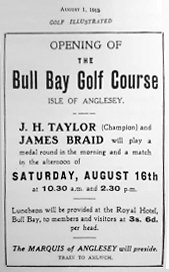
It was against this background that Saturday, August 16th 1913 saw the official opening of the Bull Bay Golf course. The laying out of the course and the building of the Clubhouse was borne by the Marquis of Anglesey on whose land the course was set out. In establishing a course at Bull Bay the Marquis hoped to develop the area as a holiday centre, especially as there were also, tennis courts and a bowling green built on the club’s land. The course was designed by Herbert Fowler of Walton Heath G C – the Marquis having engaged him to design another course for him on land at Beau Desert in Staffordshire. Fowler made the most of undulating land without any concerns about asking the golfer to take on blind shots or carrying lengthy distances.
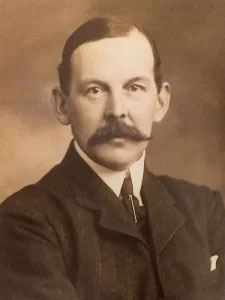
The opening of the course attracted over a thousand people and teeing off were two well-known golfers of the time J H Taylor and James Braid both of whom had won the Open on five occasions. Lunch was taken at the Royal Hotel at Bull Bay. In the afternoon Taylor partnered T. Simpson of Eastbourne in a match against Braid and W. H. Fowler the course designer.
With the onset of the First World War (1914 – 18) the Club experienced financial difficulties. Annual running costs amounted to an average of £500 per year and the Clubs revenue for the period amounted to £1215 (including membership fees by green fees) 1n 1920 a letter was forwarded to members stating that it was now for local people to work out the situation to the satisfaction of the Marquis. A committee of eleven was established to run the club – six chosen by the Marquis and five by the members. The popularity of the game was increasing and in February 1922 Mr and Mrs Lewis Williams were appointed to the post of professional and stewardess at a joint salary of £2.00 per week.
In October 1925 the club agreed to pay the Marquis £4,000 for the land – members assisted by purchasing debentures. The club’s financial position was still a concern and it was agreed that all available building sites on the Club’s land be mapped out and valued in order to sell. There was general concern as to the condition of the course too – the general belief being that the green staff didn’t work the required hours. On the course it was agreed ‘to get something mechanical’ for the cutting and rolling work – replacing Prince, the horse which had served the club so well for several years. The outset of the Second World War meant that playing the actual game took a backseat. The course was used by a local Home Guard for exercise and several competitions were staged to raise funds for the War efforts.
After the hostilities golf started slowly and the total membership of the club in 1948 stood at 156 (105 male, 51 female) – the popularity of the game increased gradually and it was agreed to set up a juvenile section. Subscriptions for 1949 were 4 guineas (£4.40 today) for gents 3 guineas (£ 3.30) for ladies. Competitively the popularity of the game was increasing and in 1949 the club appointed W B Jones as its first competition secretary. Mr Lloyd Thomas who has supported the club financially during the Second World War continued to do so until his death in 1954. There was great deal of concern about the condition of the of the clubhouse and the club’s financial position remained precarious – a building improvement account was set up. Discussions continued in the early 1960’s regarding the Clubhouse and in February 1962 plans were drawn up for the construction of a new Clubhouse. The project was financed mainly by selling twelve plots of building land @£5,000 where the currents Links estate is situated – the sale of this land meant redesigning this part of the course.
With the oncoming of the Wylfa Power Station membership expanded and a new group of members, the Wylfa membership appeared. The increase in membership numbers naturally led to more competitive golf and several new trophies appeared. The junior section also flourished, and several youngsters were recognised regionally or nationally including Bob Wrench who went on to gain success weightlifting at the New Zealand Commonwealth Games in 1972. John Robert Jones was elected the first junior Captain.
In the early seventies the Shell Oil Co. contacted the club regarding the possible course of a pipeline from an off shore oil buoy to a tank farm at Rosch. In 1974 work began on the pipeline which meant playing restrictions and partial re designing of the 11th, 12th and 13th holes. The club benefited financially to the sum of £20,000. The mid-seventies were an exciting time for the club and in October 1977 membership stood at 705 The club dominated inter club competitions on Anglesey winning the Dr Lowe shield and Rawlinson shield on several occasions and further afield registering success in the Caernarfonshire and District inter club competitions.
In 1979 the club staged its first popular Pro-Am competition International recognition came to the club in July 1987 when it hosted the European school’s international championship – further recognition has come to the club with the hosting of the Welsh Boys Championship and the national inter Counties championship. The deterioration in the condition of the clubhouse meant that in November 1982 it was agreed to go ahead and build a new clubhouse which was opened in March 1994.
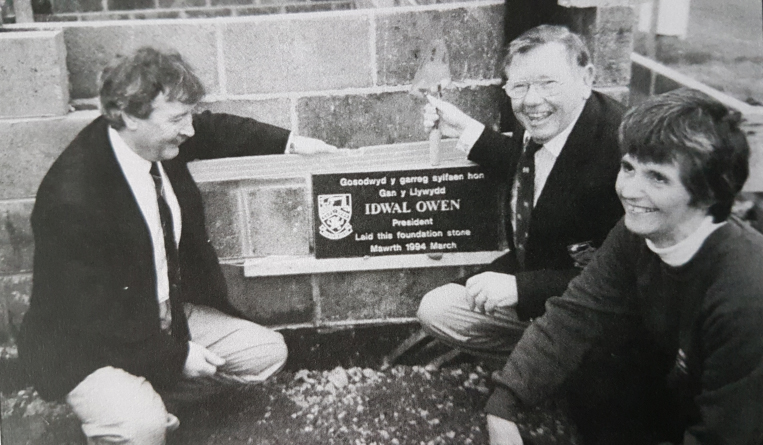
Several members have achieved international recognition. Aled Llyr and Emyr Jones having represented the men’s team and Jane Rogers, Helen Lawson and Sue Turner the women’s team. The club celebrated its Centenary in 2013 and a wide range of events attracted members and visitors from near and far to celebrate the notable event in the history of the club.
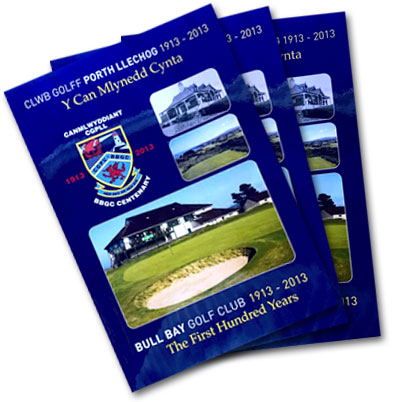
Copies of the book, “Bull Bay Golf Club 1913 to 2013 The First Hundred Years” are for sale in the club shop and office.